Topic 2: Written Communication & Business Correspondence
Lesson 1: Fundamentals of Written Communication
Written communication is the innovative activity of carefully choosing and organizing written words in correct sentence structures to pass information from one person or entity to another. It serves as a cornerstone for both internal and external business interactions, providing structure, permanence, and formality to organizational dialogue.
Definition and Core Characteristics:
- Definition: Any type of interaction that makes use of written words to pass information, including letters, memos, reports, and emails.
- Permanent Record: Unlike oral communication, written documents provide a lasting record for future reference and legal defense.
- Formality and Precision: Tends to be more formal and explicit, requiring careful planning and clear expression to avoid ambiguity.
Advantages of Written Communication:
- Clarity and Precision: Allows for careful wording and editing to ensure the message is exact and unambiguous.
- Permanent Record: Serves as a reliable, verifiable reference for decisions, agreements, and historical data.
- Legal Validity: Documents like contracts, orders, and official letters have legal standing and can be used as evidence.
- Delegation of Responsibility: Clearly assigns tasks and accountability, as instructions and roles are documented.
- Wide Access: Can be distributed to many recipients simultaneously, regardless of location.
- Foundation for Policies: Essential for laying down and disseminating organizational policies, rules, and procedures.
Disadvantages of Written Communication:
- Time-Consuming: Writing, editing, and distributing documents is slower than speaking.
- Delayed Feedback: The sender must wait for a written reply, slowing down the problem-solving process.
- High Cost: Involves costs for stationery, printing, postage, and storage.
- Lack of Spontaneity: Inhibits immediate clarification and lacks the nuance of tone and body language.
- Requires Literacy: Excludes illiterate senders or receivers and demands strong language skills from the writer.
- Bureaucratic Burden: Can lead to excessive paperwork (“red tape”) that slows organizational processes.
Rules for Effective Writing (The 6 C’s):
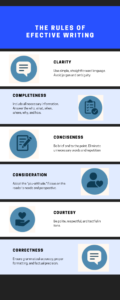
- Clarity: Use simple, straightforward language. Avoid jargon and ambiguity.
- Completeness: Include all necessary information. Answer the who, what, when, where, why, and how.
- Conciseness: Be brief and to the point. Eliminate unnecessary words and repetition.
- Consideration: Adopt the “you-attitude.” Focus on the reader’s needs and perspective.
- Courtesy: Be polite, respectful, and tactful in tone.
- Correctness: Ensure grammatical accuracy, proper formatting, and factual precision.