Topic 4: Non-Verbal, Visual, & Electronic Communication
Lesson 5: Mechanical Barriers, Noise, and Integration
For all its power, electronic and visual communication faces significant technical and human obstacles.
Mechanical and Technical Barriers:
- Definition: Obstacles arising from the machinery or instruments used for communication.
- Examples:
- Hardware/Software Failure: Crashed computers, software bugs.
- Network Issues: Poor connectivity, bandwidth limitations, server downtime.
- Incompatibility: Files or software that cannot be opened by the receiver.
- Power Outages.
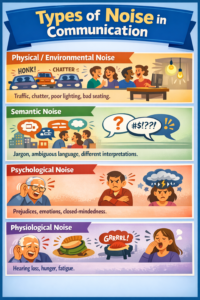
Noise in Communication:
- Definition: Any interference that distorts or disrupts the message during transmission.
- Types:
- Physical/Environmental Noise: Actual sound (traffic, chatter), poor lighting, bad seating.
- Semantic Noise: Caused by words themselves (jargon, ambiguous language, different interpretations).
- Psychological Noise: Prejudices, emotions, closed-mindedness in the sender/receiver.
- Physiological Noise: Biological factors (hearing loss, hunger, fatigue).
Overcoming Barriers and Noise:
- Redundancy: Sending the same message through multiple channels (e.g., follow-up email after a call).
- Simplicity and Clarity: Using plain language and confirming understanding.
- Technical Checks: Testing equipment before important meetings.
- Active Listening and Feedback: To catch and correct misunderstandings early.
- Choosing the Right Medium: Matching the channel to the message’s complexity and urgency.
Integrated Communication Strategy:
- No single channel is perfect. The most effective communicators use an integrated mix:
- Use email for formal, non-urgent records.
- Use the phone for quick clarification and personal touch.
- Use videoconferencing for remote team meetings.
- Use face-to-face for sensitive issues, negotiations, and relationship building.
- Use visual aids to support and clarify complex points in any medium.
Mastery of non-verbal, visual, and electronic communication is essential in the modern digital workplace. It involves not just knowing how to use the tools, but understanding their strengths, limitations, and the ethical implications of their use to build clear, effective, and professional interactions.